261008-01Thu, 08 Oct 2026
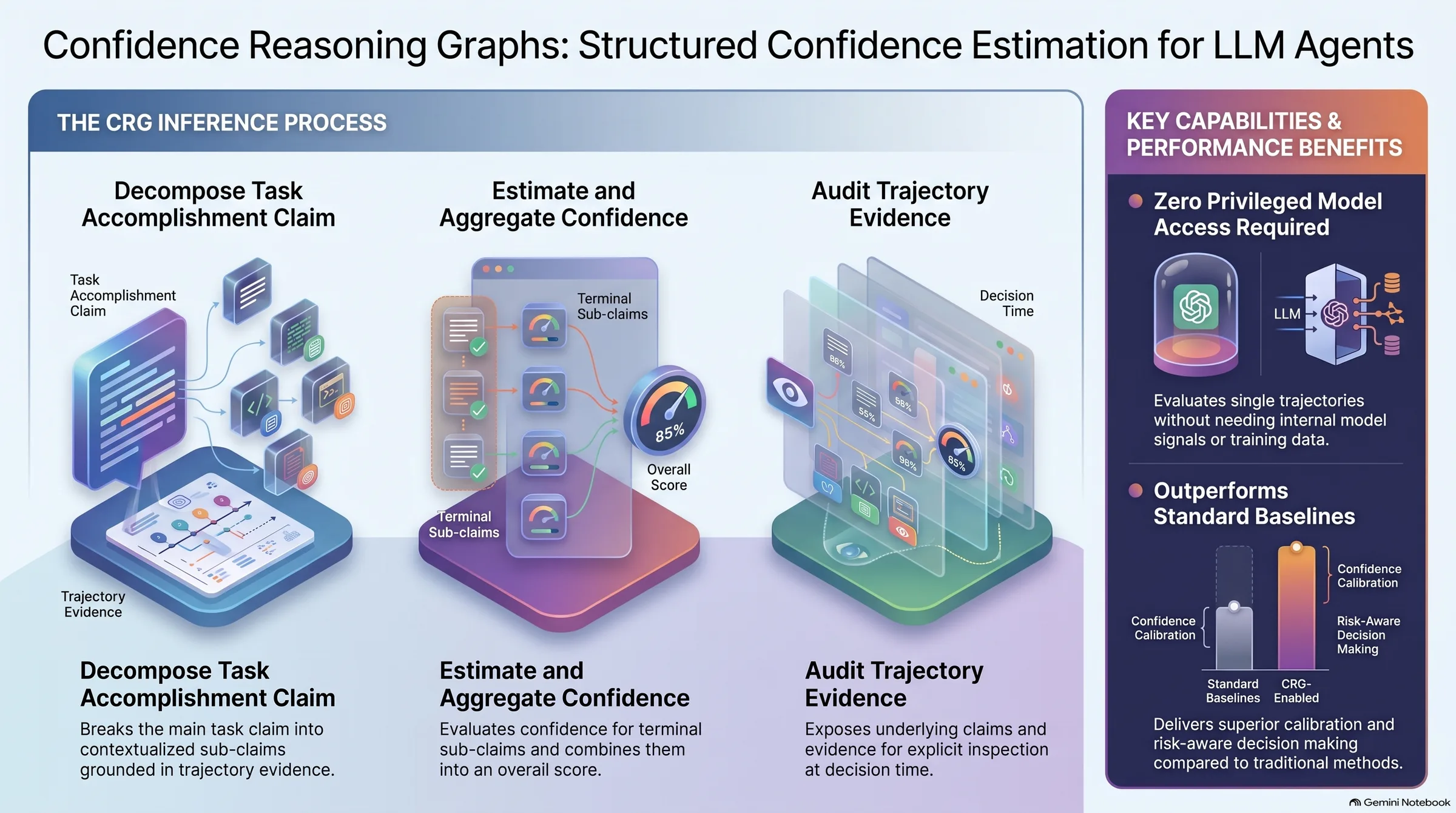
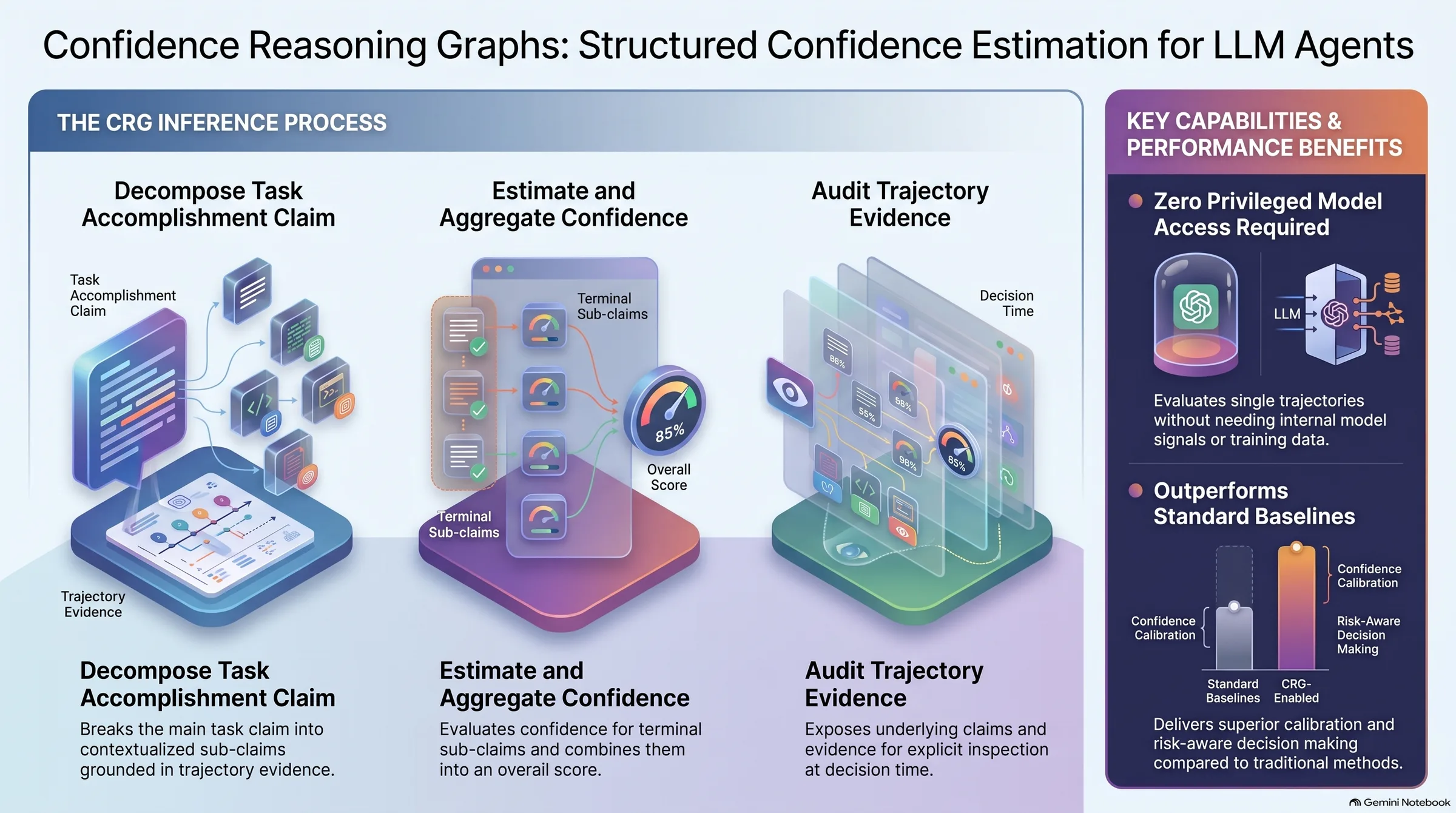
New paper: Confidence Reasoning Graphs give calibrated, auditable answers to "did the agent actually succeed?"
Researchers at Megagon Labs and UC Santa Cruz estimate how likely an agent is to have succeeded from a single finished run, with no access to the model's internals and no training data. The method breaks the claim "the agent did its task" into smaller claims tied to evidence from the run, scores each one and multiplies the scores together. On SWE-Bench Verified, EnterpriseOps-Gym and SkillsBench it had the best calibration (adaptive ECE 0.09, 0.13 and 0.11, against 0.18 to 0.49 for simply asking the model how confident it is), the best Brier scores and the best decision utility, at about $0.04 to $0.07 per estimate. The authors also warn that a baseline with low calibration error was barely better than chance at telling successes from failures, so calibration error alone can mislead.
Why it matters Decision models handle fast choices before an action. This tackles the matching problem afterwards: a cheap, inspectable, calibrated check on whether an agent's work can be trusted. It's also a caution against calibration leaderboards that report ECE alone.
Sources
- arXiv 2610.07948 cited, not licensed
- GitHub (Megagon Labs) cited, not licensed
Infographic and catalog copy © AK, CC-BY-4.0. Linked sources are cited, not licensed.
On this thread
Recurring name
SWE-Bench Verified
Full thread → Aleph Alpha releases Kolibri, a sovereign open-weight German–English model
 Reflection AI unveils Beam, a 501B open-weight model pitched as the West's answer to DeepSeek and Qwen
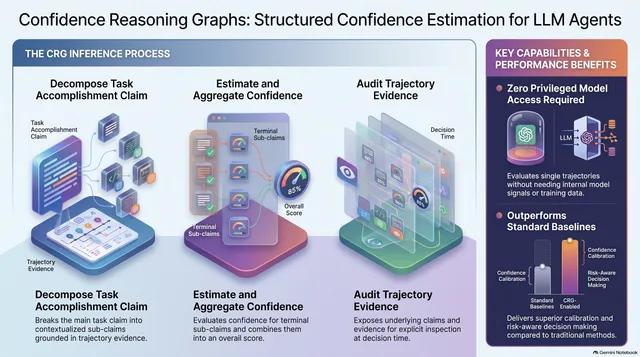 New paper: Confidence Reasoning Graphs give calibrated, auditable answers to "did the agent actually succeed?"This frame