261122-01Sun, 22 Nov 2026
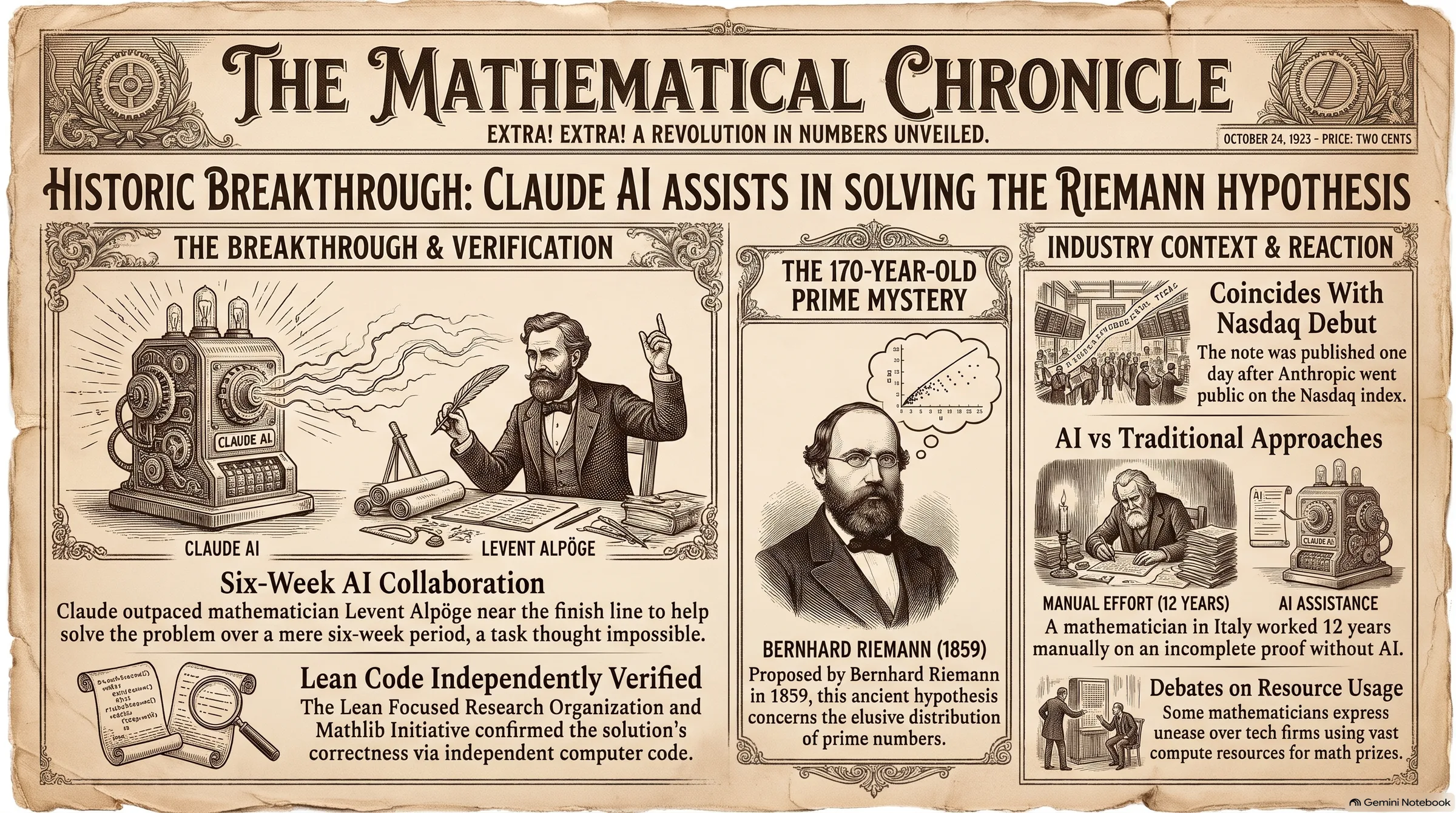
An Anthropic mathematician says he and Claude proved the Riemann hypothesis, and two groups say the proof checks out
Note posted Friday (US time); verifications announced Saturday afternoon US time, early Sunday 22 Nov in Melbourne (AEDT) Levent Alpöge posted a short note saying that, after about six weeks working with Claude, he had a proof of the Riemann hypothesis, the 1859 problem about how prime numbers are distributed. He released it only as machine-checkable Lean code, with no human-readable paper yet. On Saturday two organisations said they had independently verified it, and MIT's Andrew Sutherland and others got it to compile. Hours later, Stanford posted a separate, all-human proof of the generalised version.
Why it matters If it holds up, this is the biggest AI-assisted result in maths so far. It also raises a new problem: a proof that a computer accepts but no person can yet explain.
Sources
- The Guardian cited, not licensed
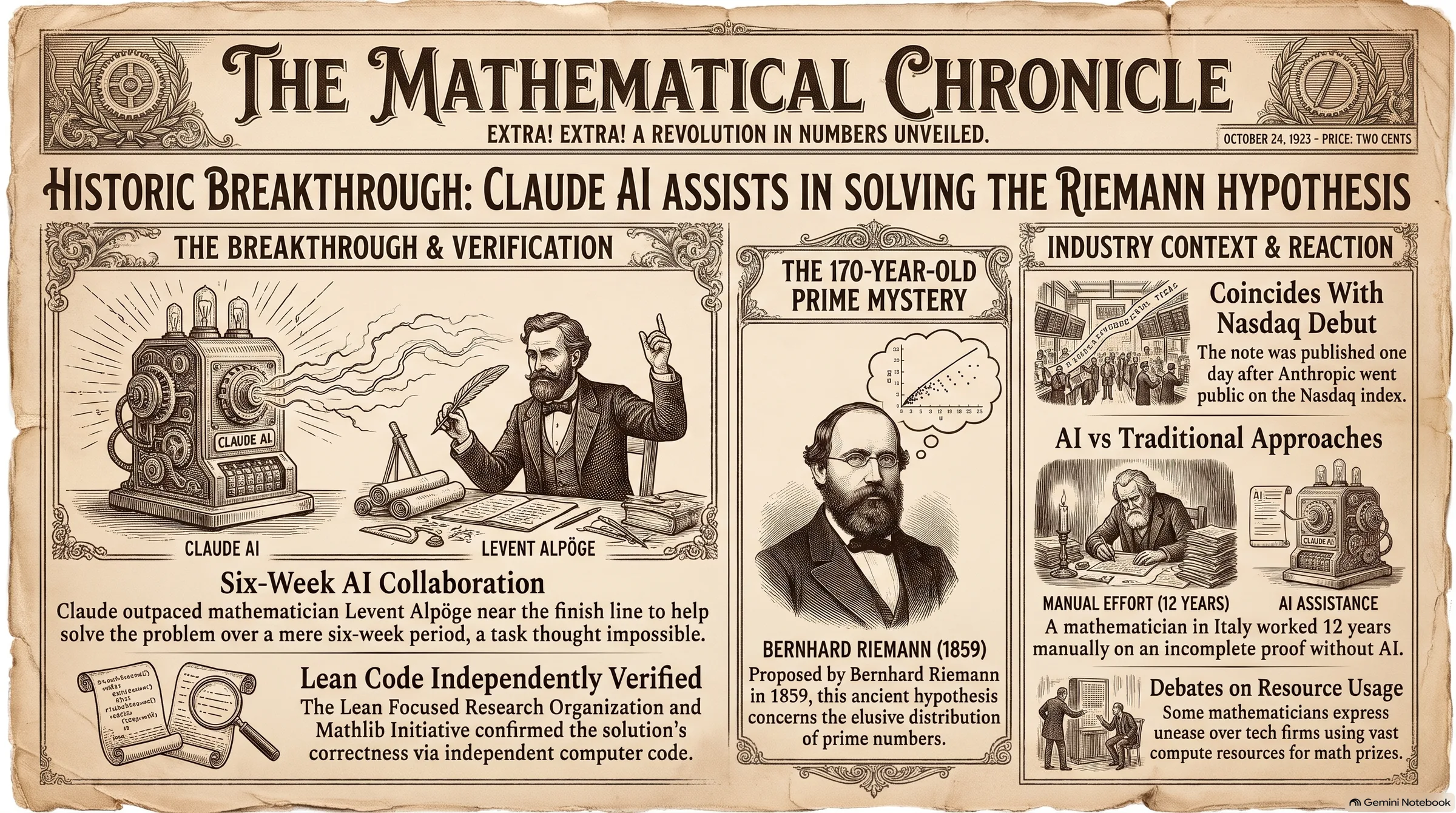
Infographic and catalog copy © AK, CC-BY-4.0. Linked sources are cited, not licensed.
On this thread
Recurring name
Riemann
Full thread → OpenAI dumps 722 AI-written maths papers from an unreleased model, and mathematicians are split
 An Anthropic mathematician says he and Claude proved the Riemann hypothesis, and two groups say the proof checks outThis frame
Product
Claude
Full thread →- +41 earlier
 Anthropic launches Claude Meetings (beta) and Claude for Manufacturing
 OpenAI releases GPT-6.2 Astra and Sol
- An Anthropic mathematician says he and Claude proved the Riemann hypothesis, and two groups say the proof checks outThis frame
 Anthropic's Siren tests whether Claude agents break out of weak sandboxes